
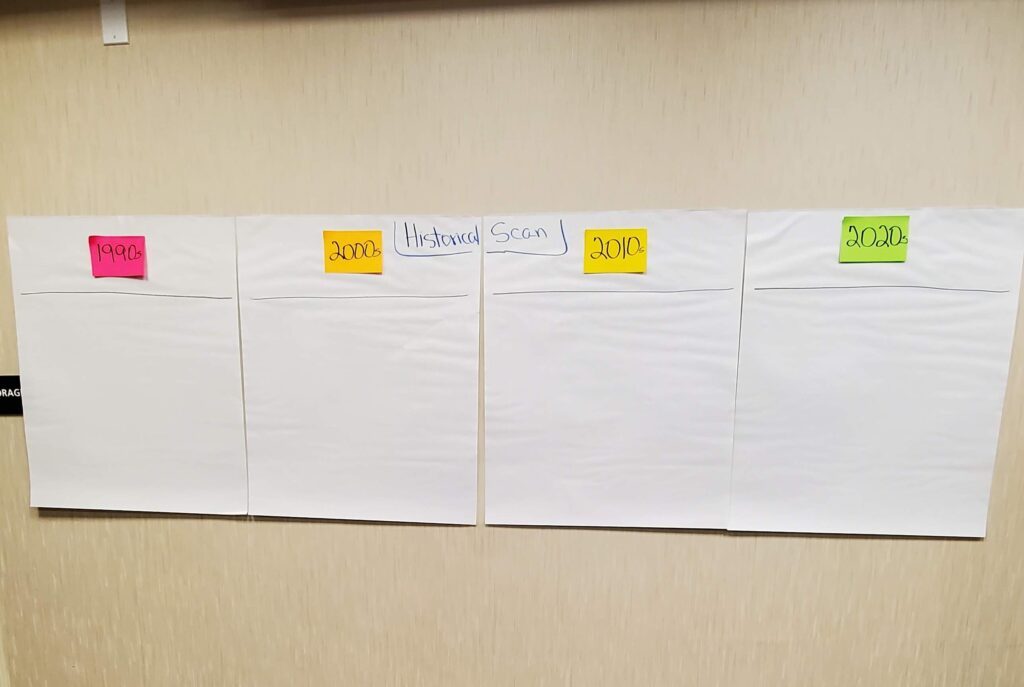
“That” was a Historical Scan activity; “this” was goal setting during a strategic planning session. The individual who said this pointed to the wall chart showing four decades of their nonprofit organization’s history and said that knowing their history helped them understand their current situation and plan for their future.
This participant’s comment speaks volumes about the power of the Historical Scan, a technique I frequently facilitate during strategic planning, team-building, issue clarification, and idea-generation sessions. Also called a Journey Wall or Wall of Wonder, the Historical Scan is a potent tool in my facilitator’s toolkit.
My colleagues and I have written about its power before, and based on the participant’s comment, it feels important to shine a light on it again. I appreciate ICA Associates Inc., from whom I learned this technique.
What is a Historical Scan?
- Draw a horizontal timeline across a wall or floor.
- Divide it into time periods.
- Invite participants, in small groups or all in one group, to identify and write down significant events from each era, and place them on the timeline.
- Discuss them using a method such as a Focused Conversation (ORID).
What unfolds is remarkable.
Why does it work so well?
It invites groups to pause and look back before rushing forward. By mapping key moments, milestones, and turning points, teams surface wisdom, honour both successes and setbacks, identify root causes of conflict, see patterns they hadn’t noticed before, and understand how the past shapes the present. It helps groups see their story with fresh eyes.
The result?
Stronger shared understanding.
Greater trust.
Clearer direction.
Sometimes, the fastest way forward is to first understand where you’ve been.
Why does it work so well?
It invites groups to pause and look back before rushing forward. By mapping key moments, milestones, and turning points, teams surface wisdom, honour both successes and setbacks, identify root causes of conflict, see patterns they hadn’t noticed before, and understand how the past shapes the present. It helps groups see their story with fresh eyes.
How has it helped groups I work with?
- During a time of turmoil, the board of a nonprofit society reflected on two decades of success and recognized its capacity to overcome current challenges.
- In one instance, a group uncovered how past relationships had quietly undermined the organization and used that insight to make intentional decisions about moving forward differently.
- In another, two founding members of a 50-year-old organization mapped its history with post-it notes across the timeline. The visual journey brought the organization’s story to life and informed newer members far more effectively than a traditional “talking head” presentation ever could.
One more thing: a Historical Scan doesn’t have to stop at your organization’s front door. Expand it to include community, national, and global events, and it becomes a powerful Environmental and Trends Scan, surfacing the forces shaping your future right now.
History isn’t just the past. It’s a map to the future.